
When I was a teenager, my mother and I would have a film night once a week. This is back in the days of Blockbuster and VHS. My mother almost always chose the films, which made sense, because she had much better taste than I did. She alway rented what we then called “foreign films”, which meant reading subtitles. Many times I would give a teenage eye roll when I saw the movie my mother brought home. But, in retrospect, I am forever grateful for her taste in cinema.
This is extra post based on a former post is dedicated to my Mother who passed away on April 16th, 2025. And, to a beautiful group of Rick Steve’s travelers who gave me more happiness than I could have ever expected from them.
From our small home in Tempe, Arizona, she opened up many worlds for me. My Mom would sit on her brown, corduroy chair with our grey schnauzer, named Swoozy, at her feet. I would be sprawled out on the oriental rug or the ugly orange couch. Each of us hugging a massive bowl of air-popped popcorn, freshly made in our new machine. Do you remember when those came out?
Through these films we traveled to China, Japan, Thailand, Italy, France and more. My family is Italian and we have an obsession with food, so most of the films had some connection to the food of each country. Still today, when I cook at home, travel, or eat out in restaurants, I recall scenes from Babette’s Feast or The Scent of the Green Papaya. Traveling through film is one of the tools that can bring us closer to other cultures. For me, it also makes me want to learn more. I want to feel the people and know what their lives are like.
I adore Anthony Bourdain, and may his soul always rest in peace. He, like my mother, gifted me a vessel through which I can attempt to understand others. Regardless of the miles and differences that separate us. Bourdain was a gift to humanity.
Many years ago, I saw a movie called Atún y Chocolate. The story is a comedy about fishermen and their families from the town of Barbate, in the province of Cádiz, Spain, struggling to survive during a fishing crisis. To understand the humor and title of the film, you need to have a grasp of the people here and what life is like for them.
I was lucky to have a relationship with a beautiful person from San Fernando, Cádiz. It was through him, his family and friends, that I was immersed in this sensorily overloaded area of Spain. His father was a fisherman by trade and his mother took care of their family and the home.
I had felt like an alien many times since I moved to Spain, but being in San Fernando with this family, made me feel like I was from Jupiter.
I met Pascual after seven years living in Granada. Let me just say that in Granada, people have a very thick accent. They swallow every ‘d’ and ‘s’, and sound like they have an entire orange in their mouth when they speak. This is not a criticism, please, and there are some people who speak clearly.
Pascual had friends from his town that were also living in Granada, and I could usually follow their conversations, more or less. Their accent was even more difficult to decipher than the Granadinos. Little did I know that when they were back home in their town of San Fernando, the accent got thicker.
Margaret meets the parents
Smile and nod. That is what you are supposed to do when you don’t understand someone. Well, let me just say that I could not understand a word his father said, not a single word. We were sitting at their dining room table eating chocos en su tinta. His father, the fisherman, was trying to explain the preparation of these cuttlefish served in their own ink, a local delicacy. He was a short and stocky man with skin the color of that burnt sienna crayon I loved when I was a little girl. He had a contagious laugh and smile, just like his son.
Seeing that I was not following a word that came out of his mouth, he began to repeat it louder and louder and made signals with his hands. We all laughed as hard as I did the day my Nana’s dentures fell out of her mouth onto the floor of her hospital room. Their sense of humor and kindness made this alien feel right at home.
The accent in this area of Spain is unlike any other I have heard before. They make Granadinos sound like they have just walked out of the Royal Spanish Academy. Lucky for me, I had that immersion course through Pascual and his family. You don’t want to miss the conversations and commentary that are happening in the local bars or markets.

The morning after the choco lunch we walked to the sea, and visited his father at work. Raising and supporting a family as a fisherman is not an easy life. For many Gaditanos, this necessity for their well-being runs deep in their blood. People in this area have been intimately connected to the sea since the time of the Phoenicians.
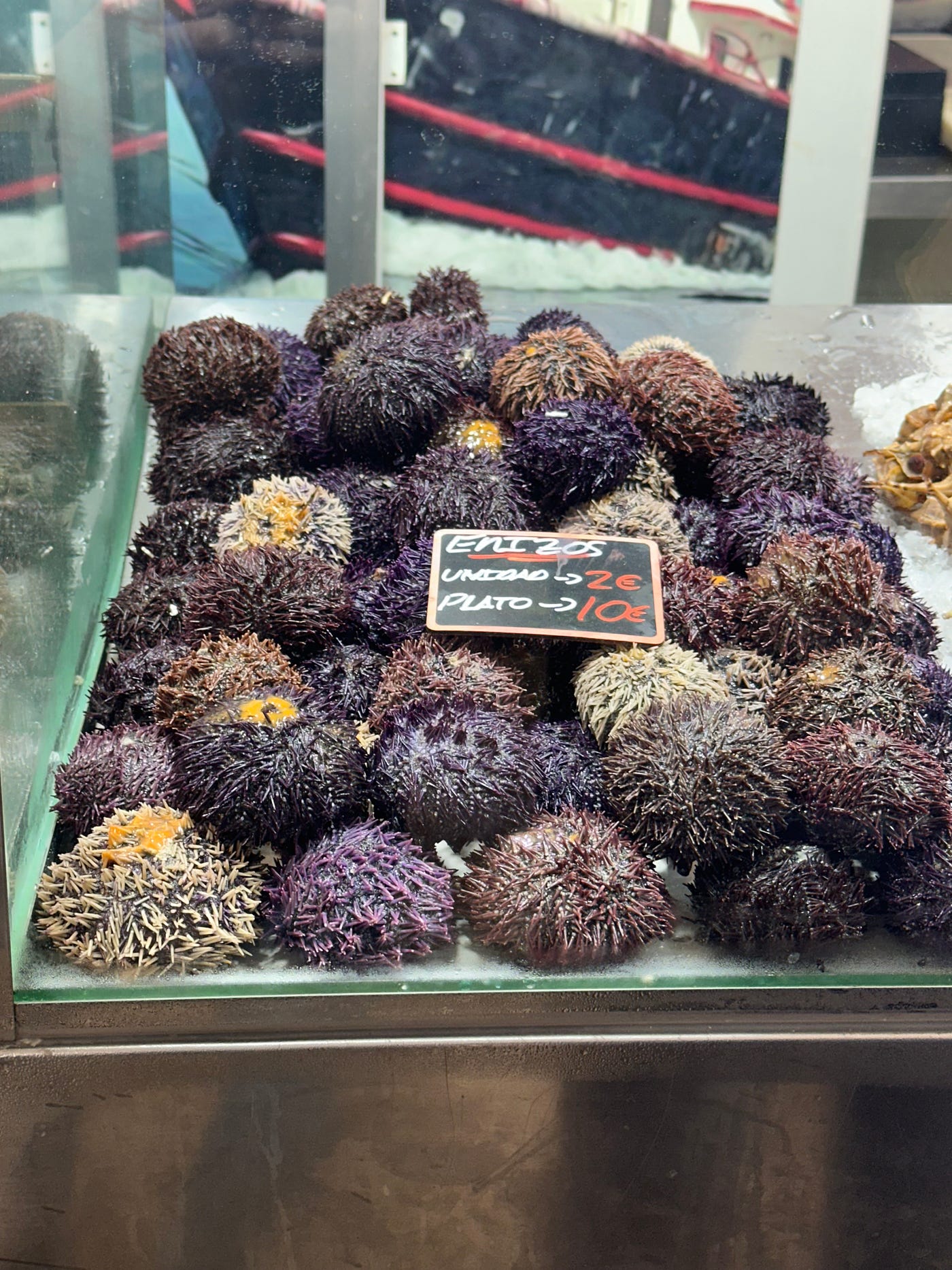
I can still close my eyes and remember that cool morning when I tasted a fresh sea urchin for the first time. His father, with thickly gloved hands, opened the dark purple, spiny shell and spooned tiny orange pieces of meat into my mouth.
In that moment, I tasted his entire life.
The differences between my family and Pascual’s were immeasurable. My mother worked in a law department, and went to work every morning in her professional clothing. My father, though he did not live with us, wore a tie everyday to his university office.
We have a saying in Spain: las comparaciones son odiosas. Comparing is hateful. It keeps us in check, and also reminds us that learning about different places and people is one of the richest gifts we can receive.
The rawness and tradition of Pascual’s family sank into my heart from the first day I met them. A feeling that is difficult to describe with words.
Now, back to the fish
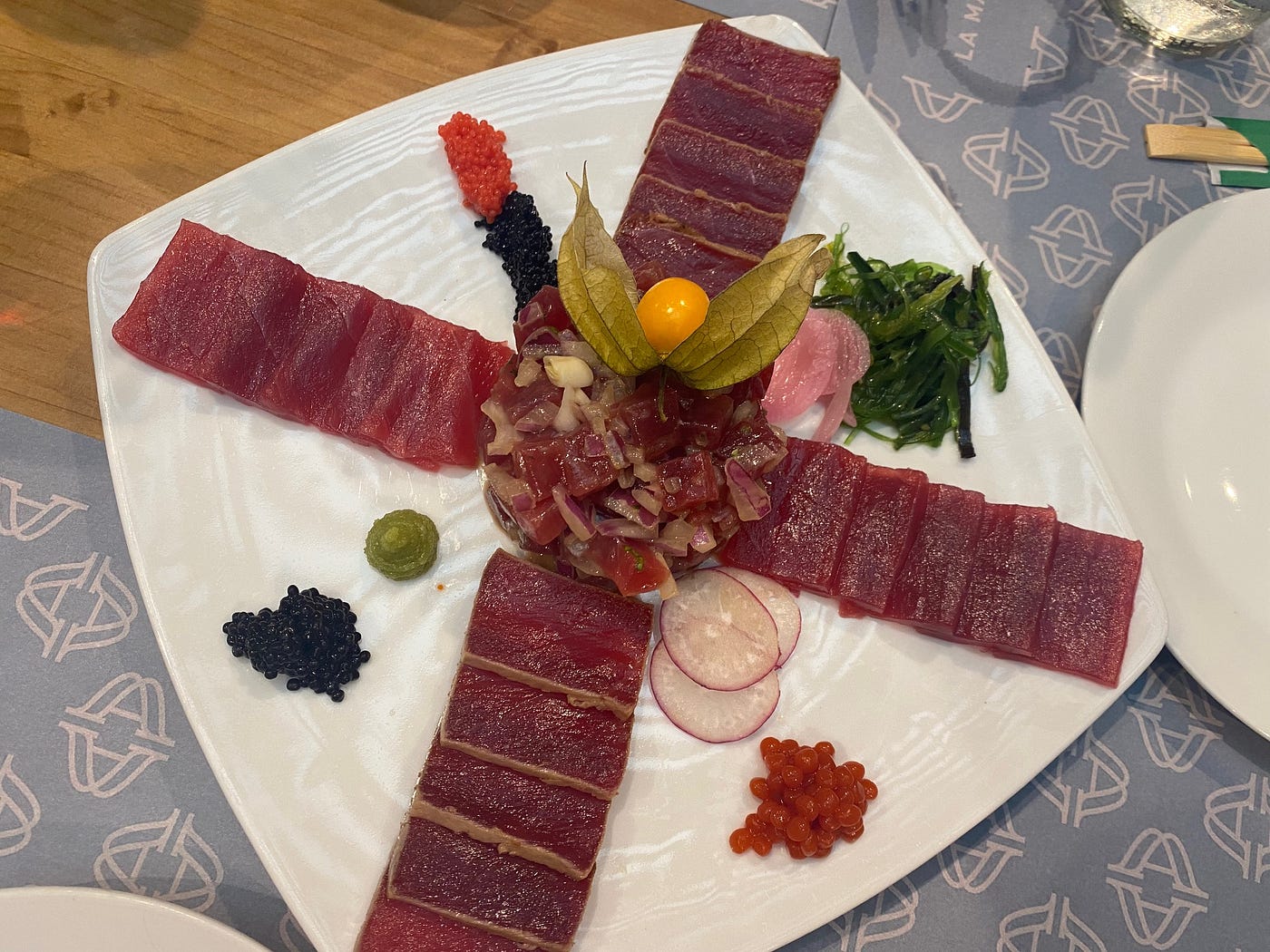
One important gastronomical treasure here is the Atún de Almadraba. The word almadraba, from Arabic, means to fight or strike. It refers to the fishing technique used to catch this highly prized bluefin tuna. Between February and July, fishing nets are strategically placed in the Atlantic waters close to the Strait of Gibraltar. Dates can vary, depending on the year and place.
In towns such as Barbate, Zahara de los Atunes, Conil de la Frontera and Tarifa, the tuna are caught in the nets on their passage to or from the Mediterranean. The nets are lifted by the fishermen into a circle of boats surrounding the nets. Maybe you have heard about the Mattanza in Sicily?

This type of fishing has been going on for 3,000 years, and is a massive source of income for the local population. At least forty percent is exported to countries like Japan.
We could talk more about the Almadraba in another article, but I just want to stress the importance of tuna and the fishing industry in Cádiz. For the people in these towns, it is a predominant part of their culture and identity. Let’s not forget to mention that the tuna is exquisite.
Yet another delicacy was born from this fishing industry. Mojama is sometimes referred to as our “ham from the sea”. We can again thank the Phoenicians for their contribution to our gastronomy, though the word is derived from Arabic. The loins of the tuna are cured in salt, washed, and then set out to dry. Traditionally, they would be dried out in the sun and air from the nearby sea. Some may say it is a acquired taste, as dried fish can be quite potent. But for most, it is as common as the popcorn that my mother and I shared.

Do you still remember the title of the film I spoke of near the beginning? Atún obviously refers to the Almadraba tuna. And, why the chocolate? Chocolate is the word used for the hashish that for years has found its way to the coastlines of Southern Spain from Morocco. While drug traffickers used to operate closer to the city of Algeciras, they now prefer the coast of Cádiz. Especially where the Guadalquivir river flows into the Atlantic ocean.
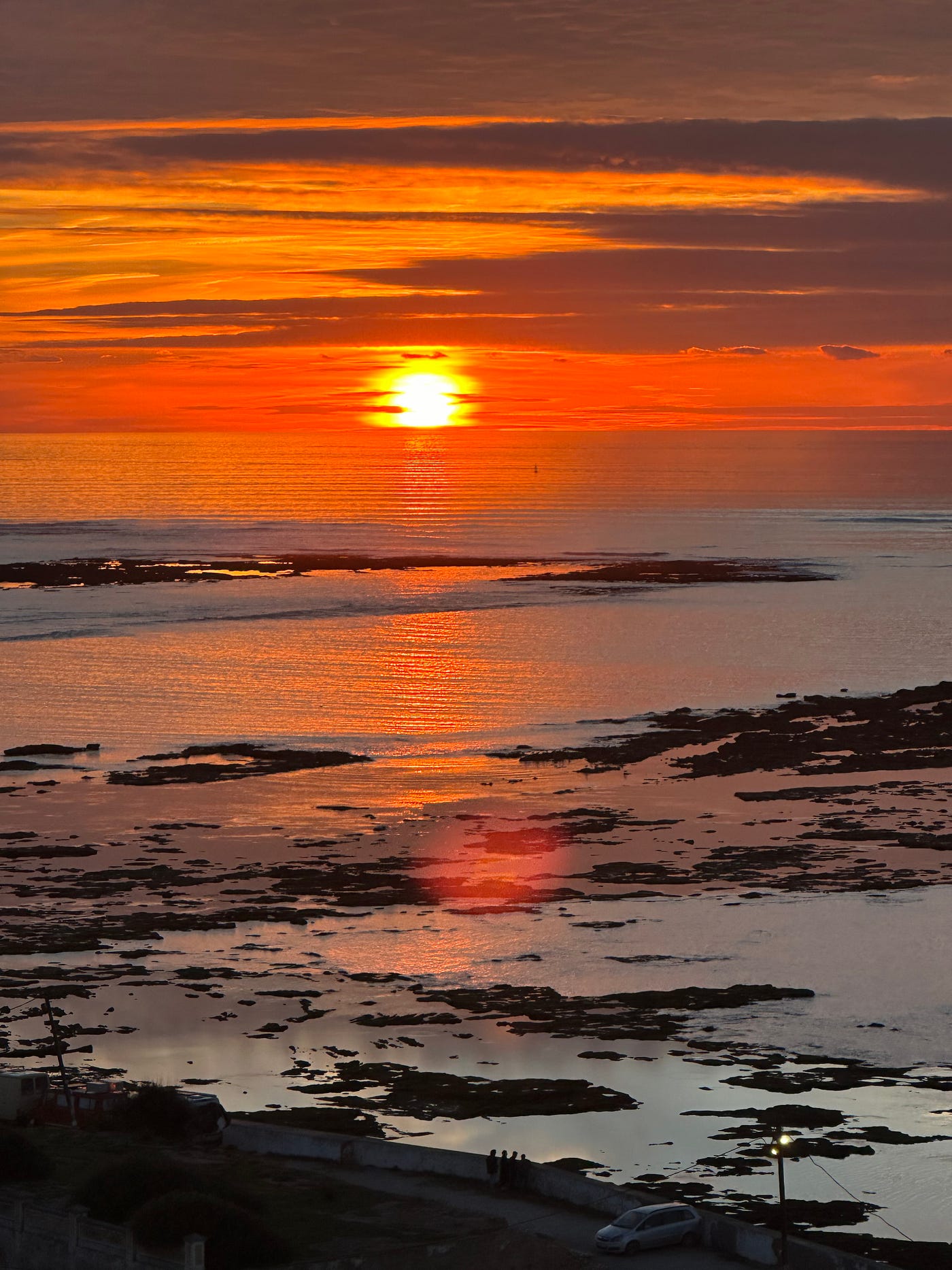
We can travel through film and documentaries, but sometimes it helps to have a deeper understanding about what we are watching. I will leave you with one of the most beautiful sunsets of my life.
As a post-reading soundtrack, I recommend “Atún y Chocolate” by Nono García and “Atunes en el Paraíso” by Javier Ruibal.
Thank you to Rui Alves for his piece about the use of language in film. He reminded me of those beautiful evenings with my mother.

 MOONINSPAIN
Leave a comment